Merida Mexico With Kids: Cenotes, Ruins and How Long to Allow
In short
The short version. Mérida is easy with children: flat streets, short walks, a free event most evenings, and cenotes that are cool all year. The one real problem is the afternoon heat, and the fix is to do everything before noon and after five. Skip the thirteen-hour day trips.
Is Mérida a good place to bring children?
Yes, and for reasons that have nothing to do with anything being built for them. The centro is flat, the blocks are short, the squares are full of families every evening, and the city puts on something free almost every night. The food is not spicy by default — the habanero comes on the side.
The one real problem is the heat, and it is a serious one from April to September: May averages 37.3 °C by day. Everything below is arranged around that.
The shape of a day that works
- Before nine: the Plaza Grande, the cathedral, the mural staircase in the Palacio de Gobierno. All free, all indoors or shaded.
- Nine to noon: one thing, out of town if you are going.
- Noon to four: lunch, a pool, a nap. This is not negotiable in summer.
- Five onwards: back out. The plazas fill up and the evening programme starts at 20:00 or 21:00.
The weather page has the month-by-month numbers if you want to see how bad the middle of the day gets.
Cenotes, which are the thing children remember
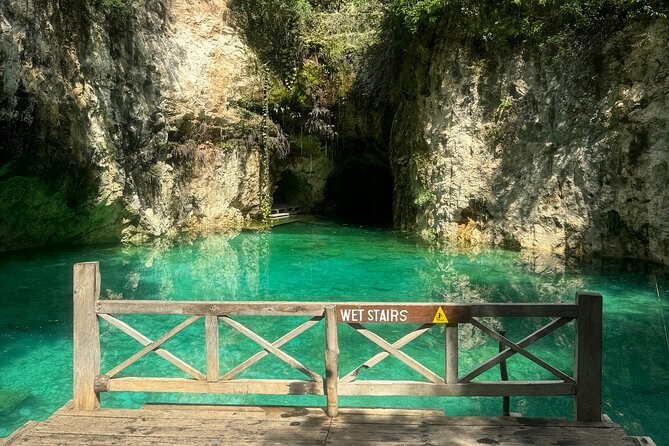
A cenote is a collapsed cave over the water table, and swimming in one is the single best thing on offer here for a child. The water is cool all year, several have shallow edges and timber stairs, and life jackets are compulsory and provided on most organised days — which solves the confidence problem before it arises.
Homún, an hour south-east, is the closest cluster and the easiest. The cenote tours page compares the three days that go there.
Ruins with children: which one, and how long
Chichén Itzá is the famous one and it is the hardest with a young child: two hours on open ground with no shade, after a two-hour drive each way. It is doable, early, with a hat and water, and plenty of families do it.
Uxmal is the easier ruin. It is closer at an hour and a quarter, it has more shade, and it is far less crowded. Dzibilchaltún is the easiest of the lot: twenty minutes north, small, and with a cenote inside the site.
How long each day trip actually takes
| Day out | Total length | Drive each way | With children |
|---|---|---|---|
| Food walk in the centro | 3 hours | None | Easy; a one-year-old has done it |
| Homún cenotes | 9 hours | 1 hour | Good — the swimming carries it |
| Uxmal and a cenote | 8–9 hours | 1 hour 15 | Manageable |
| Chichén Itzá and Izamal | 12 hours | 2 hours | Long; take the earliest departure |
| Las Coloradas | 13 hours | 3 hours 30 | Not with young children |
The pattern is obvious once it is written down: the drive, not the destination, is what makes a day hard. The map and distances page has every destination with its timing, and the day tours from Merida are listed with their total length so you can see it before you book.
Evenings, which are the easy part
The free programme is genuinely good for families. Pok Ta Pok, the Maya ball game played in front of the cathedral on Saturday evenings, is forty minutes of fire and noise and is the one children talk about afterwards. The Vaquería on Monday is dancing with trays balanced on heads. Sunday closes the streets entirely for the Biciruta and Mérida en Domingo.
Things to do lists all of it with times and locations.
Eating with children
Straightforward. Panuchos and salbutes are essentially small tortillas with things on top; sopa de lima is a mild chicken broth; marquesitas are a crisp wafer rolled around cheese and chocolate and sold from carts on the plazas in the evening. Nothing arrives hot unless you add the habanero yourself. The food page explains what each one is.
Practical bits
- Pushchairs: fine in the centro, which is flat, though the pavements are narrow and high. Several operators mark their vans as stroller accessible.
- Age minimums: several day trips set one, usually 12 or 13. Check the listing before you book rather than at the van, because they are not consistent.
- Child fares: most operators publish a reduced rate, and one cooking class is free for under-fives.
- Cash: the gates and the market stalls are cash, so carry pesos.
- Water: more than you think. There is no shade at the ruins and the walk between structures is on open grass.
- Toilets: at every archaeological site and every organised cenote, and nowhere in between on a two-hour drive.
Where to stay, and why it matters here
Stay in the centro. It is not a general recommendation so much as a logistical one: almost every tour meets within four blocks of the Plaza Grande, the evening events are all in the same square kilometre, and you can walk home from dinner at nine with a tired child rather than finding a taxi. Hotels further north on Paseo de Montejo are quieter and greener, and they cost you a car ride at 06:30 on the mornings that matter.
A pool is worth paying for in a way it is not in most cities. Between noon and four you will want somewhere to be, and that is the difference between a good week and a fought one.
One day that is worth skipping
Las Coloradas is thirteen hours with three and a half of driving each way and no shade at the destination. It is a genuinely remarkable place and it is the wrong day out with children under about ten. If the pink water is the thing you came for, put it on a trip without them, or accept that most of it will be spent in a van.
Everything else is between two and twelve hours, and the length is on every card before you book.
Frequently asked questions
Do children pay?
Can I swim with sunscreen on?
When does it rain?
How big are the groups?
Days out that work with children
4 Cenotes Tour in Homún all inclusive from Merida
Three Homún cenotes with every entrance fee and lunch already paid.
From $87 per person
Check AvailabilityMerida Walking Food Tour. Authentic & Local Cuisine
Three hours, eight tastings, two markets, and everything you drink included.
From $72 per person
Check AvailabilityMerida : 4 Santa Barbara Cenotes and Bikes with Lunch
Cycle between four cenotes, with a Maya pyramid stop on the way out.
From $110 per person
Check AvailabilityBuilding a week around nap times? The shorter days — the food walk, the cenotes, the two-hour city walk — are the ones that survive it, and Merida Mexico Tours shows the length of every trip before you book.