Cenote Tours from Merida Mexico
Hours, prices and access verified by the Merida Mexico Tours team — last checked 2026-09-05.
A cenote is a sinkhole where a cave roof has collapsed over the water table, and the Yucatán has thousands of them because it has almost no rivers. Three days out of Mérida are built entirely around swimming in them, and all three include every entrance fee — which, given each pool charges its own in cash, is most of the reason to book one.
Cenote tours of Merida Mexico
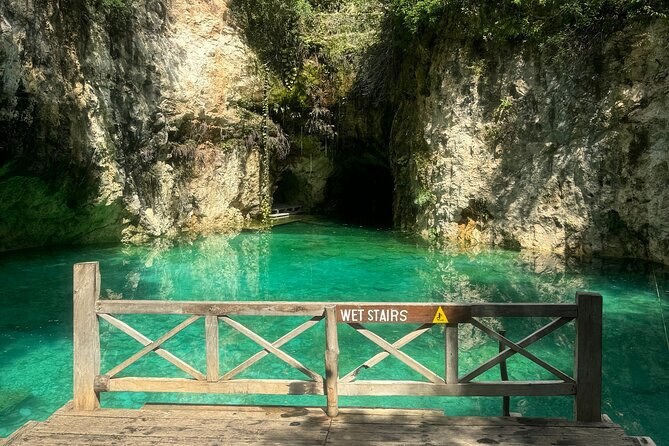
★★★★★ 4.9 (175 reviews · 9 hours)
To the cenotesParque Santa LucíaA meal includedMax 19
Three Homún pools with every entrance fee inside the fare, plus lunch, a mask and a life jacket. An hour out rather than two, and the only cenote day where you never take your wallet out.
From $87 per person
Free cancellation up to 24 hours ahead.
Top rated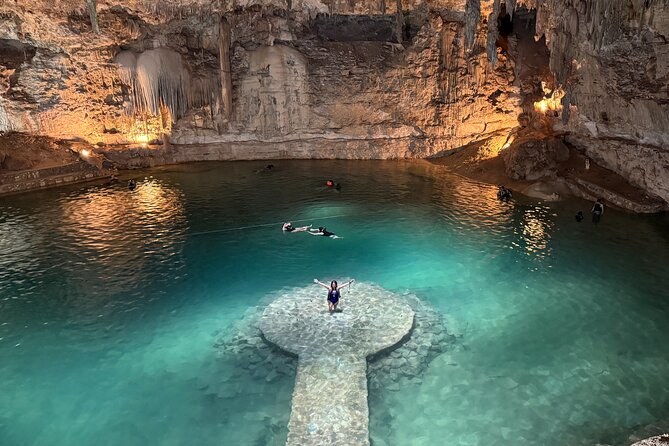
★★★★★ 5 (105 reviews · 12 hours)
To the cenotesParque Santa LucíaA meal includedMax 19
Suytún's stone platform, Oxman's rope swing and Real Dzonot, with an hour and a half in colonial Valladolid between them. Twelve hours, lunch and every cenote ticket included. Lockers cost extra.
From $99 per person
Free cancellation up to 24 hours ahead.
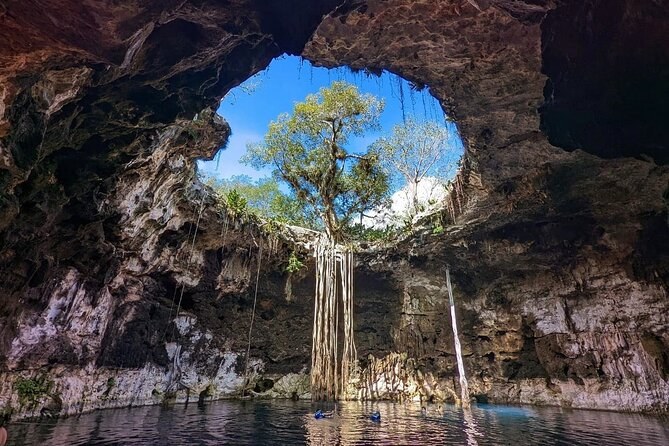
★★★★★ 4.8 (101 reviews · 8 to 9 hours)
To the cenotesDowntown hotel pickupA meal includedMax 20
Cycle between four pools instead of being driven to them, with a Maya pyramid at Acanceh on the way out. Site fee, bicycle, life jacket and food included; there is a van for anyone who would rather not pedal.
From $110 per person
Free cancellation up to 24 hours ahead.
Book a cenote day
Three pools, every entrance fee and lunch, from a nine-hour day an hour out of the city.
See Top Tours
What a cenote day out of Mérida actually is
A short drive and a long swim. Homún is an hour south-east, Valladolid two hours
east, Santa Bárbara an hour. Each day visits three or four pools with lunch
somewhere in the middle, and you are in and out of the water from mid-morning
onwards.
The pools are not interchangeable. An open cenote is a bright round pool with vines
dropping to the water; a semi-open one has a hole in the roof and a shaft of light; a
cavern cenote is reached down a stair and lit artificially. A good day visits more than
one kind, which is the argument for a day trip over a single famous pool.
Everything here is easy physically — timber stairs, short walks, no hiking —
and wet from the first stop.
Why choose a cenote day
Every entrance fee is already paid
Cenotes around Homún are run by families and ejidos and each charges its own
cash fee at its own gate. All three of these days cover them.
The heat stops mattering
The water is underground and sits in the low twenties whatever the surface is doing.
In May, when the daily maximum averages 37.3 °C, this is the best day you can have in
the Yucatán.
Life jackets are compulsory and provided
Which makes these days work for people who do not swim well, and that is worth knowing
before ruling them out.
You would not find them alone
There is no public transport between the Homún pools, and choosing three good
ones out of thirty takes local knowledge.
Cenote tours vs a hire car and a map
Around Valladolid you can do it yourself with a bus and taxis. Around Homún it
is considerably harder.
| A guided cenote day | Driving yourself |
|---|
| Entrance fees | Included on all three days | Cash at each gate, 100-200 pesos each |
| Which pools | Three or four, chosen for variety | Whichever you can find |
| Equipment | Life jacket and mask provided | Bring or hire your own |
| Lunch | Included on all three days | Yours to find |
| Transport between pools | In the fare | Your car, or a bicycle on one day |
| Flexibility | Fixed times | Complete |
| Cost | From From $87 all in | Car, fuel and every fee |
Check availability on the Homún day
The car wins if you are four people who want to linger. The organised day wins on cost
for two, on variety, and on not carrying six hundred pesos in small notes.
The cenote guide names ten of them with
their types and drive times.
What you get, and what you do not
In every fare: return transport, a certified guide, every cenote
entrance fee, a life jacket, and lunch.
In some: a snorkel mask (two of three), a bicycle between the pools
(one of three), an hour and a half in a colonial town (one of three).
In none: drinks beyond what is served with lunch, gratuities, and
lockers on the Valladolid day.
Arrive wearing your swimsuit, and leave the sunscreen
in the hotel. The changing facilities are basic, and one operator asks for no
sunscreen at all because it goes into the water table. Wear a rash vest instead, and pack
water shoes —
the FAQ page covers the rest of the cenote
rules.
Planning a cenote day
Price band: about $87 to $110 a head, with every fee inside it.
Length: eight to twelve hours. The nine-hour Homún day is the
shortest because the drive is one hour rather than two.
Booking window: two to three days outside the peak season. These sell
less far ahead than the ruins days.
Best time of day: first thing. Suytún's shaft of light is a
mid-morning phenomenon and the queue builds behind it; the Homún pools can be empty
at ten and busy by noon.
Who should choose something else
If you want a town as well as a swim, the Valladolid day is the one of
these three that gives you one, and
a Chichen Itza day puts a ruin and the yellow town of
Izamal either side of Cenote Ik Kil.
If you have back problems or find stairs difficult, two of these days
say so in their own notes. The descents are timber stairs and ladders, and Suytún
has the easiest access of the pools listed here.
If you will not get in the water, do not book one. The swimming is the
day; the drive is flat scrub. Take the food walks or the historic centre instead.
If it is your only day out of the city and you have never seen a Maya
site, take the ruins. The cenotes will still be there next time, and
Chichén Itzá is the thing you will be asked about.
Frequently asked questions
Are the flamingos at Celestún there all year?
No, and it is worth planning around. CONANP puts the largest concentrations between November and February, when up to 50,000 birds gather, and one operator's own listing calls sightings highly inconsistent from April to mid-November. The mangroves, the freshwater spring and the crocodiles are there whatever the month.
Can I swim with sunscreen on?
Not on the Homún day, whose operator bans sunscreen outright to protect the water. Elsewhere, wear a rash vest or a long-sleeved top instead of lotion. Most cenotes ask you to rinse in their showers before you get in.
How early do the day trips leave Merida Mexico?
Early. The small-group Chichén Itzá day picks up from 05:30, the shared van checks in at 07:00, and the cenote days start at 08:00. The reason is the same every time: reaching the site before the coaches from Cancún and before the worst of the heat.
Do children pay?
The tour fares vary and several products publish a discounted child rate, with one cooking class free for under-fives. One Chichén Itzá operator states that children of 12 and under enter the site free. Check the age bands on the listing before you book, because they differ — one day sets its minimum age at 13.
Can I cancel a tour if my plans change?
Yes. Every tour we list offers free cancellation up to 24 hours before the start time, for a full refund. Inside 24 hours the operator keeps the fare and changes are not accepted either, so move the date rather than leaving it.
Ready to book?
Every one of these refunds in full up to 24 hours ahead, so the date is reversible right to the day before. From From $87 per person.
See Top Tours
Where to go next
If none of these is quite right, Merida Mexico Tours lists every day out of the city
side by side, and the map and distances page shows how far each one
goes. The visiting page covers what a day here costs before you
add a tour to it.