Merida Mexico Barrio by Barrio: Every Plaza, Market and Church Worth the Walk
In short
The short version. Mérida is a set of old barrios, each with a plaza, a church and a market or a food street. Centro is the grandest, Santa Lucía the prettiest, Santa Ana the one that eats best, Santiago the least touristed. Walk them north to south in one long morning, or take one a day and use the evenings.
How the barrios work
Colonial Mérida was laid out as a Spanish centre with Maya and mestizo barrios around it, each built around its own church and square. The centre has moved on; the structure has not. Six of them still function as neighbourhoods with their own evening life, and they are close enough together to walk between in ten minutes.
The city's numbered grid makes this easy to follow. Even streets run north–south, odd ones east–west, and the Plaza Grande sits inside Calle 60, 61, 62 and 63. Every barrio below is given by its junction.
Centro: the Plaza Grande and its four sides
The square is unusually complete, with the cathedral east, the Palacio de Gobierno north, the Palacio Municipal west and the Casa de Montejo south. All four are free to walk into, and the mural staircase inside the Palacio de Gobierno is the single best half hour in the city. The highlights page takes each building separately.
Sit on one of the confidante chairs on the square, the S-shaped double seats that face two people in opposite directions, and you can see the whole thing at once.
Santa Lucía: Calle 60 x 55
Four blocks north of the Plaza Grande, and the prettiest square in the city: a stone arcade on two sides, restaurant tables under it, and the church at one end. On Thursday evenings it fills up an hour before the Serenata de Santa Lucía starts at 21:00.
It is also the practical centre of the day-trip business. The shared vans check in at an office on Calle 58 at the corner of 57, right beside the square.
Santa Ana: Calle 47 x 60
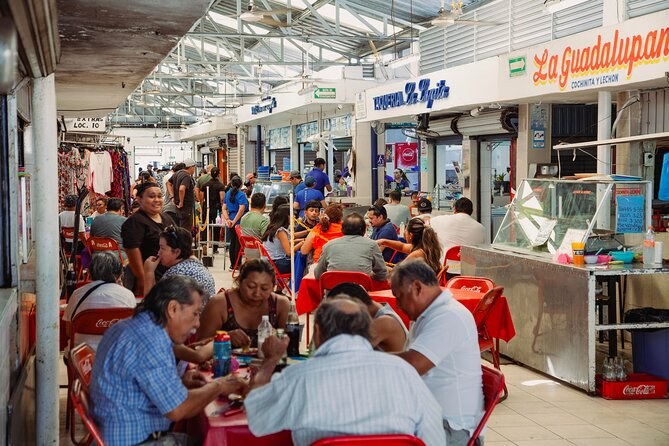
Two blocks further north, on the way to Paseo de Montejo. The plaza has a food hall on one side that runs from breakfast until late, and it is the least self-conscious eating in the centro — plastic chairs, one dish per counter, no menus in English.
Two tour operators park along Calle 47 here, so if your voucher says Parque Santa Ana this is where to stand.
Santiago: Calle 72 x 57 y 59
West of the centre, and the barrio with the least tourism in it. The market beside the church is a working one, the plaza has an enormous tree in the middle, and on Tuesday evenings the city runs Remembranzas Musicales here from 20:00 — couples dancing to a band, and almost nobody watching who is not local.
One of the food walks starts in this barrio and crosses three markets from here.
La Mejorada: Calle 59 x 50
East of the centre, quieter, built around a large church and a long plaza. It has the folk-art and popular-song museums and a couple of very good restaurants, and it is where the centro stops feeling like a centre.
San Sebastián and the southern edge
South-west, past the market district, and the least visited of the six. It is the one to walk if you want to see how the grid works when nobody is maintaining it for visitors: same church, same plaza, no restaurants with English menus.
Which barrio for what
| Barrio | Junction | Go for | Best time |
|---|---|---|---|
| Centro | Calle 60 x 61 | The four buildings on the square | Morning, or Sunday all day |
| Santa Lucía | Calle 60 x 55 | The arcade and the Thursday Serenata | Thursday, 20:00 |
| Santa Ana | Calle 47 x 60 | Eating, cheaply and well | Breakfast or late evening |
| Santiago | Calle 72 x 57 | The market and Tuesday's dance | Tuesday, 20:00 |
| La Mejorada | Calle 59 x 50 | Museums and restaurants | Afternoon |
| San Sebastián | South-west of the market | The city without an audience | Any evening |
A walking order that works
- Start at the Plaza Grande before nine, while it is still cool.
- North up Calle 60 to Santa Lucía, then Santa Ana.
- Onto Paseo de Montejo as far as your patience holds — it is longer and hotter than it looks.
- Back by car for the middle of the day.
- Out again after five to Santiago or La Mejorada.
That is about four hours of actual walking split across a day, which is the right amount here. The weather page explains why the middle of it is a bad idea from April to September.
Doing it with a guide
The two-hour walk of the historic centre covers Centro and the bottom of Calle 60 with a certified local guide, and it is the cheapest thing you can book in the city. The food walks cover the market barrios instead. Both are among the Merida walking tours listed with their prices, and things to do has what is on in each plaza by night.
Frequently asked questions
How hot does it get?
What is there to do in the evening?
What is a cenote?
Tours that walk these barrios
Walking Tour Across the Historic Center in Merida
Two hours, a certified local guide, and under twenty dollars a head.
From $18 per person
Check AvailabilityMérida Food Tour: Markets and Street Flavors
Four and a half hours, three markets, and step-free the whole way.
From $95 per person
Check AvailabilityMerida Walking Food Tour. Authentic & Local Cuisine
Three hours, eight tastings, two markets, and everything you drink included.
From $72 per person
Check AvailabilityWant the buildings explained as you pass them? A certified local guide turns two hours of walking into the whole history of the city — Merida Mexico Tours lists the walks with their prices and start points.