Flamingo Season From Merida Mexico: When to See Them and Where
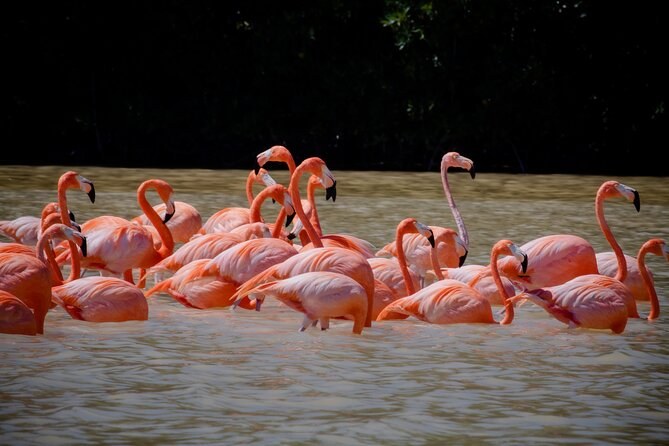
Almost every operator sells a flamingo trip as a year-round product and the birds do not cooperate. The Caribbean flamingo winters on one coast of this peninsula and breeds on the other, and the difference between going in January and going in August is the difference between fifty thousand birds and a handful.
When are the flamingos actually at Celestún?
November to February for the largest concentrations. That is CONANP's own figure — the federal agency that runs Mexico's protected areas — and it puts the peak-month count at up to 50,000 birds in the Ría Celestún Biosphere Reserve.
The operators agree, which is rarer than it should be. One Celestún listing states in its own notes that the best season runs mid-November through March and that sightings from April to mid-November are highly inconsistent. Two independent sources, one answer.
Why are they seasonal at all?
Because Celestún is a wintering ground rather than a home. The Caribbean flamingo (Phoenicopterus ruber) feeds and rests on the western coast of the peninsula through the winter, then moves up to 300 km north-east to breed in the Ría Lagartos reserve.
So the birds are on the peninsula all year. They are simply not in the same place, and Celestún is the one an hour and a half from Mérida.
Celestún or Ría Lagartos: which should you go to?
| Celestún | Ría Lagartos and Las Coloradas | |
|---|---|---|
| From Mérida | 90 km west, 1 hour 30 | 220 km north-east, 3 hours 30 |
| Typical day length | 7 hours 30 to 9 hours | 13 hours |
| Best months | November to February | Spring and summer, when they breed |
| Peak count | Up to 50,000 birds | The breeding colony |
| Also on the trip | Mangroves, a freshwater spring, a beach | The pink salt pans, a boat, a beach |
| Best for | A flamingo day from Mérida | The pink water, with birds as a bonus |
The short version: go to Celestún in winter for the birds, and to Las Coloradas whenever for the pink water. Do not go to Celestún in August expecting the photograph.
What do you see out of season?
A great deal, and it is worth saying so rather than writing the summer off. The mangrove channels are the point of the boat trip whatever month it is: narrow tunnels of root and branch, a freshwater spring bubbling up inside them, and crocodiles in the shallows along the edges.
Add pelicans, spoonbills, herons and a colony of raccoons working the visitor centre. The Celestún days also all include a beach afternoon on the Gulf, and that part is the same in June as it is in January.
Month by month, what to expect
| Months | Flamingos | Weather | Verdict |
|---|---|---|---|
| November–February | Peak, up to 50,000 | Dry, 30–32 °C | Go now |
| March | Still strong | Driest month | Excellent |
| April–May | Thinning fast | 36–37 °C | Go for the mangroves |
| June–August | Lowest of the year | Wet and hot | Go for the beach |
| September–October | Beginning to return | Wettest, hurricane season | Marginal |
The best time to visit sets that against everything else you might want from the same trip, and the weather page has the temperature and rainfall behind it.
Which Celestún tour should you take?
Three days run there from Mérida and they are meaningfully different.
The nine-hour boat day includes lunch, a certified nature guide, binoculars and three hours on Playa Norte, and it checks in on Calle 58 at 08:00.
The seven-and-a-half-hour excursion is the shortest and includes the beach club facilities, but not lunch and not the boat — the visitor centre and the boatmen are cash only and the operator asks you to bring 500 pesos each.
The eight-and-a-half-hour trip has the longest time on the water at three hours, including the hidden spring, and excludes lunch and drinks.
Is the boat included in the price?
On two of the three, yes. On the third it is not, and that is the single most important thing to check before you book a Celestún day: one operator's fare covers the vehicle, the guide and the beach club but leaves you to pay the reserve and the boatmen in cash on arrival.
Neither approach is wrong — the cash one is cheaper up front — but arriving without 500 pesos in your pocket is a problem you cannot solve at the pier. The FAQ page covers what is cash-only across the whole state.
How close do you actually get?
Closer than you expect, and that is regulated rather than accidental. The boats work the shallows at a distance the reserve sets, and the flocks carry on feeding while a boat comes in. Flamingos in flight are the shot everybody wants and nobody can promise.
Bring binoculars if you have them. One operator provides them; the others do not.
What else is on the same day?
All three Celestún days pair the reserve with the coast. Playa Norte is a wide, shallow Gulf beach and the water is warm and calm; the beach clubs have showers, loungers and somewhere to eat.
Some trips add a stop in the mangroves where a freshwater spring rises through the salt water, and one includes a Maya clay bath — the part of the day nobody books for and everybody remembers.
Are the flamingos wild, or is this a park?
Wild, and the distinction matters. Ría Celestún is a federally protected biosphere reserve rather than an attraction, and CONANP staff run an environmental education centre at it. Nothing is fed, nothing is fenced, and the birds are there because the water suits them.
That is also why nobody can promise you a sighting. In the winter months the odds are overwhelming — the concentrations run to tens of thousands — and in August they are genuinely poor. An operator selling a guaranteed flamingo photograph in July is selling you something they do not control.
The reserve's other function is worth knowing. It is one of the wetland systems on this coast that the whole peninsula's fresh water passes through, which is the same water table you swim in at the cenotes — the cenote tours page explains that half of it.
Do you need to book ahead?
Between November and February, yes — that is peak flamingo season and peak tourist season at once, and the smaller operators cap at twelve to eighteen travellers. Two to five days is usually enough; over Christmas and Carnaval, longer.
Out of season you can often book the day before. Everything refunds in full up to 24 hours ahead either way.
What else lives in the Ría Celestún reserve?
A great deal, and it is the reason the reserve exists rather than a bird park. The mangrove channels hold herons, egrets, spoonbills, pelicans and cormorants year round, and the reserve is a designated biosphere reserve precisely because the whole wetland system matters rather than one species.
In the summer months you are more likely to come home with a crocodile photograph than a flamingo one. They sit in the shallows along the channel edges and the boatmen know where. There is also a freshwater spring, an ojo de agua, bubbling up through the salt water deep in the mangroves, where the boats stop and some operators let you get in.
Raccoons and coatis work the visitor centre at the landward end, and they get as much attention as anything with feathers.
How does the boat trip actually work?
You arrive at the visitor centre or the pier, the group is split across small open boats holding six or so, and a local boatman takes each one out. That is worth knowing in advance, because on a larger departure one guide cannot be in every boat — a traveller in January 2026 describes exactly that problem, with an English-speaking guide in one boat and nobody in theirs.
The run goes out into the shallow water where the flamingos feed, then back into the mangrove channels, which is the part that surprises people. The channels are narrow, the canopy closes over the top, and it is the closest thing to a tunnel of trees on this coast.
Ask which boat your guide is in before you get into one, and if the group is large, get into that one.
What we would do
Travelling between November and February: take a Celestún day and take it early in your trip, in case the weather closes the boats and you need a second attempt.
Travelling between April and October: go for the mangroves and the beach, and treat any flamingo you see as a bonus. If the birds are the whole point of the trip, spend the day on cenote tours from Merida instead and come back in the winter.
Either way: check whether the boat is in the fare before you book. The three days differ on exactly that, and they are set out with their inclusions on Merida Mexico Tours.
Frequently asked questions
What is Yucatecan food?
Do the cenotes charge separately?
Can I cancel a tour if my plans change?
Do I need to tip?
The three flamingo days
Boat tour through the mangroves of Celestún and Playa from Merida
Mangroves, a spring, three hours of beach, and binoculars provided.
From $107 per person
Check AvailabilityTour to Celestún with View of Flamencos and Beach Club
More time in the mangroves than either of the other Celestún trips.
From $145 per person
Check AvailabilityExcursion to Celestun Biosphere and Beach Day from Merida
The shortest coast day here, half reserve and half beach club.
From $72 per person
Check Availability